Whiting Sterling Silver Flask
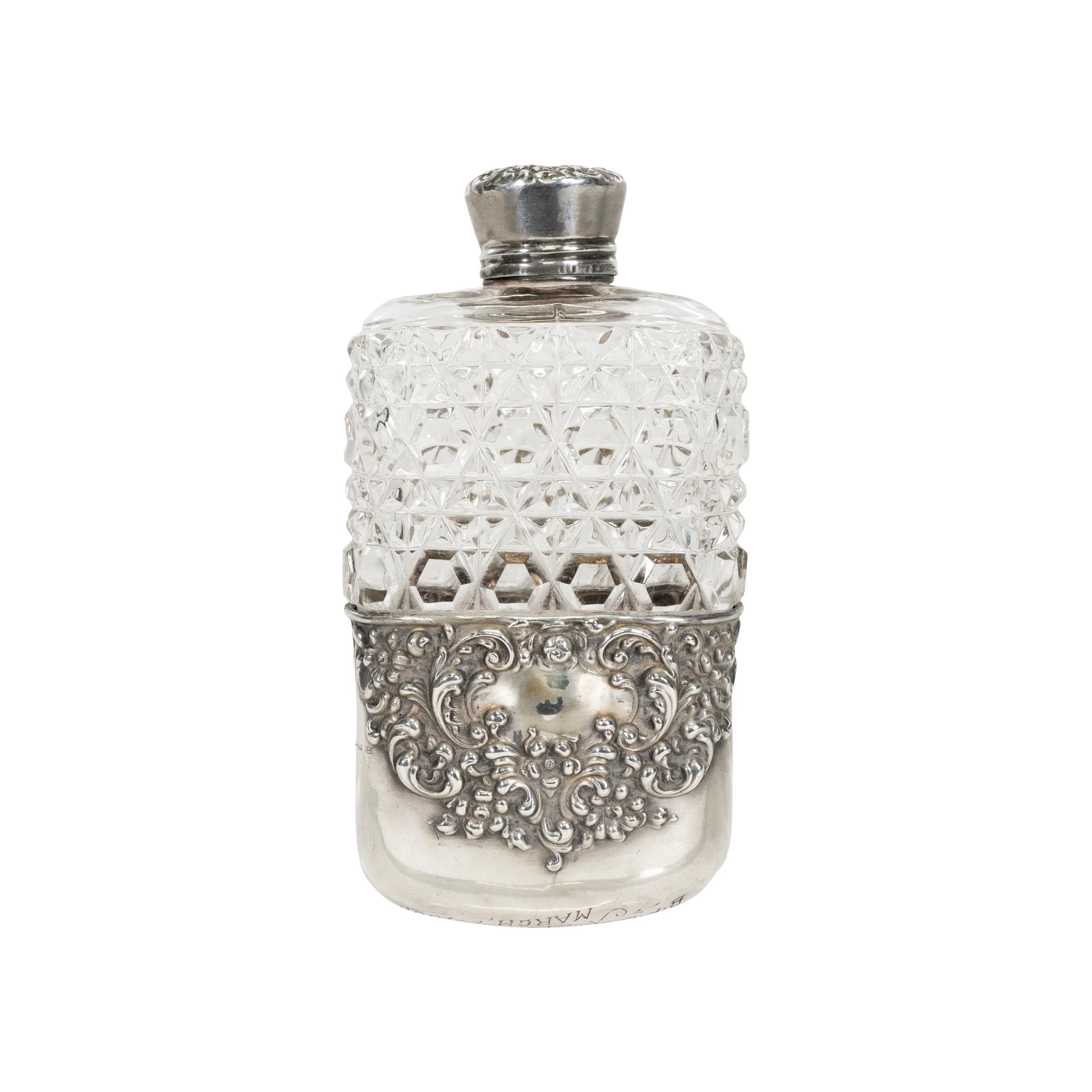
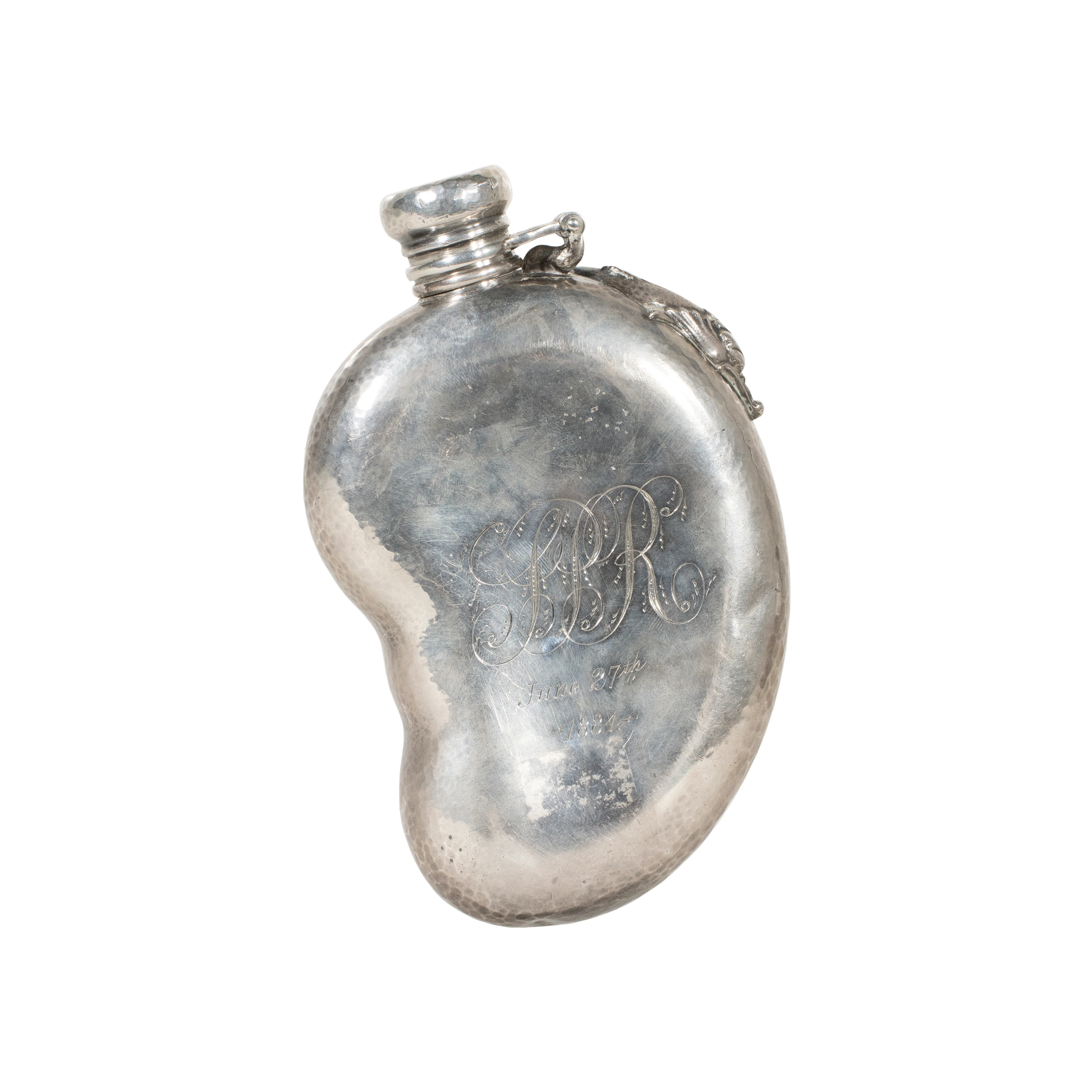
Whiting sterling silver flask. Woman in a wave on front, dolphin near hinge, monogrammed with date on back, and hammered on sides and cap. Whiting Manufacturing Co traces its origin to the firm Tifft & Whiting formed in 1840 by Albert C. Tifft and William Dean Whiting.
After the retirement of Tifft the firm changed to Whiting & Gooding (& Co) in 1853, Whiting Fessenden & Cowan (1858), Tifft Whiting & Co (1859, re-entering of Tifft), Whiting Cowan & Bowen (1864) until its forming as Whiting Manufacturing Co in 1866. The factory, located in North Attleboro, Massachusetts, was destroyed by a fire in 1875. What was salvaged by the ruins was acquired by F, Jones and the production transferred to New York combining its manufacturing operations and offices into one building at 692-694 Broadway at Fourth Street. The company was purchased by Gorham in 1924 and the production transferred to Providence, Rhode Island. Whiting had relatively small production output but produced exceptional handmade silverware in relatively small quantities. The Company's most famous and important designer was Charles Osborne. In the 1880's he worked for Tiffany for a period of time before returning to Whiting. His designs are some of the most important of the American aesthetic movement.
From 1905 to 1924 the firm marked its production with date symbols.
Whiting was absorded by Gorham in 1926. 6 1/4"L, 254.4 grams
After the retirement of Tifft the firm changed to Whiting & Gooding (& Co) in 1853, Whiting Fessenden & Cowan (1858), Tifft Whiting & Co (1859, re-entering of Tifft), Whiting Cowan & Bowen (1864) until its forming as Whiting Manufacturing Co in 1866. The factory, located in North Attleboro, Massachusetts, was destroyed by a fire in 1875. What was salvaged by the ruins was acquired by F, Jones and the production transferred to New York combining its manufacturing operations and offices into one building at 692-694 Broadway at Fourth Street. The company was purchased by Gorham in 1924 and the production transferred to Providence, Rhode Island. Whiting had relatively small production output but produced exceptional handmade silverware in relatively small quantities. The Company's most famous and important designer was Charles Osborne. In the 1880's he worked for Tiffany for a period of time before returning to Whiting. His designs are some of the most important of the American aesthetic movement.
From 1905 to 1924 the firm marked its production with date symbols.
Whiting was absorded by Gorham in 1926. 6 1/4"L, 254.4 grams
PERIOD: Late 19th Century
ORIGIN: New York, United States
SIZE: 6 1/4", 254.4 grams.
$1,575.00
Original: $4,500.00
-65%Whiting Sterling Silver Flask—
$4,500.00
$1,575.00More Images


Whiting Sterling Silver Flask
Whiting sterling silver flask. Woman in a wave on front, dolphin near hinge, monogrammed with date on back, and hammered on sides and cap. Whiting Manufacturing Co traces its origin to the firm Tifft & Whiting formed in 1840 by Albert C. Tifft and William Dean Whiting.
After the retirement of Tifft the firm changed to Whiting & Gooding (& Co) in 1853, Whiting Fessenden & Cowan (1858), Tifft Whiting & Co (1859, re-entering of Tifft), Whiting Cowan & Bowen (1864) until its forming as Whiting Manufacturing Co in 1866. The factory, located in North Attleboro, Massachusetts, was destroyed by a fire in 1875. What was salvaged by the ruins was acquired by F, Jones and the production transferred to New York combining its manufacturing operations and offices into one building at 692-694 Broadway at Fourth Street. The company was purchased by Gorham in 1924 and the production transferred to Providence, Rhode Island. Whiting had relatively small production output but produced exceptional handmade silverware in relatively small quantities. The Company's most famous and important designer was Charles Osborne. In the 1880's he worked for Tiffany for a period of time before returning to Whiting. His designs are some of the most important of the American aesthetic movement.
From 1905 to 1924 the firm marked its production with date symbols.
Whiting was absorded by Gorham in 1926. 6 1/4"L, 254.4 grams
After the retirement of Tifft the firm changed to Whiting & Gooding (& Co) in 1853, Whiting Fessenden & Cowan (1858), Tifft Whiting & Co (1859, re-entering of Tifft), Whiting Cowan & Bowen (1864) until its forming as Whiting Manufacturing Co in 1866. The factory, located in North Attleboro, Massachusetts, was destroyed by a fire in 1875. What was salvaged by the ruins was acquired by F, Jones and the production transferred to New York combining its manufacturing operations and offices into one building at 692-694 Broadway at Fourth Street. The company was purchased by Gorham in 1924 and the production transferred to Providence, Rhode Island. Whiting had relatively small production output but produced exceptional handmade silverware in relatively small quantities. The Company's most famous and important designer was Charles Osborne. In the 1880's he worked for Tiffany for a period of time before returning to Whiting. His designs are some of the most important of the American aesthetic movement.
From 1905 to 1924 the firm marked its production with date symbols.
Whiting was absorded by Gorham in 1926. 6 1/4"L, 254.4 grams
PERIOD: Late 19th Century
ORIGIN: New York, United States
SIZE: 6 1/4", 254.4 grams.
Product Information
Product Information
Shipping & Returns
Shipping & Returns
Description
Whiting sterling silver flask. Woman in a wave on front, dolphin near hinge, monogrammed with date on back, and hammered on sides and cap. Whiting Manufacturing Co traces its origin to the firm Tifft & Whiting formed in 1840 by Albert C. Tifft and William Dean Whiting.
After the retirement of Tifft the firm changed to Whiting & Gooding (& Co) in 1853, Whiting Fessenden & Cowan (1858), Tifft Whiting & Co (1859, re-entering of Tifft), Whiting Cowan & Bowen (1864) until its forming as Whiting Manufacturing Co in 1866. The factory, located in North Attleboro, Massachusetts, was destroyed by a fire in 1875. What was salvaged by the ruins was acquired by F, Jones and the production transferred to New York combining its manufacturing operations and offices into one building at 692-694 Broadway at Fourth Street. The company was purchased by Gorham in 1924 and the production transferred to Providence, Rhode Island. Whiting had relatively small production output but produced exceptional handmade silverware in relatively small quantities. The Company's most famous and important designer was Charles Osborne. In the 1880's he worked for Tiffany for a period of time before returning to Whiting. His designs are some of the most important of the American aesthetic movement.
From 1905 to 1924 the firm marked its production with date symbols.
Whiting was absorded by Gorham in 1926. 6 1/4"L, 254.4 grams
After the retirement of Tifft the firm changed to Whiting & Gooding (& Co) in 1853, Whiting Fessenden & Cowan (1858), Tifft Whiting & Co (1859, re-entering of Tifft), Whiting Cowan & Bowen (1864) until its forming as Whiting Manufacturing Co in 1866. The factory, located in North Attleboro, Massachusetts, was destroyed by a fire in 1875. What was salvaged by the ruins was acquired by F, Jones and the production transferred to New York combining its manufacturing operations and offices into one building at 692-694 Broadway at Fourth Street. The company was purchased by Gorham in 1924 and the production transferred to Providence, Rhode Island. Whiting had relatively small production output but produced exceptional handmade silverware in relatively small quantities. The Company's most famous and important designer was Charles Osborne. In the 1880's he worked for Tiffany for a period of time before returning to Whiting. His designs are some of the most important of the American aesthetic movement.
From 1905 to 1924 the firm marked its production with date symbols.
Whiting was absorded by Gorham in 1926. 6 1/4"L, 254.4 grams
PERIOD: Late 19th Century
ORIGIN: New York, United States
SIZE: 6 1/4", 254.4 grams.