Skookum Store Display Doll
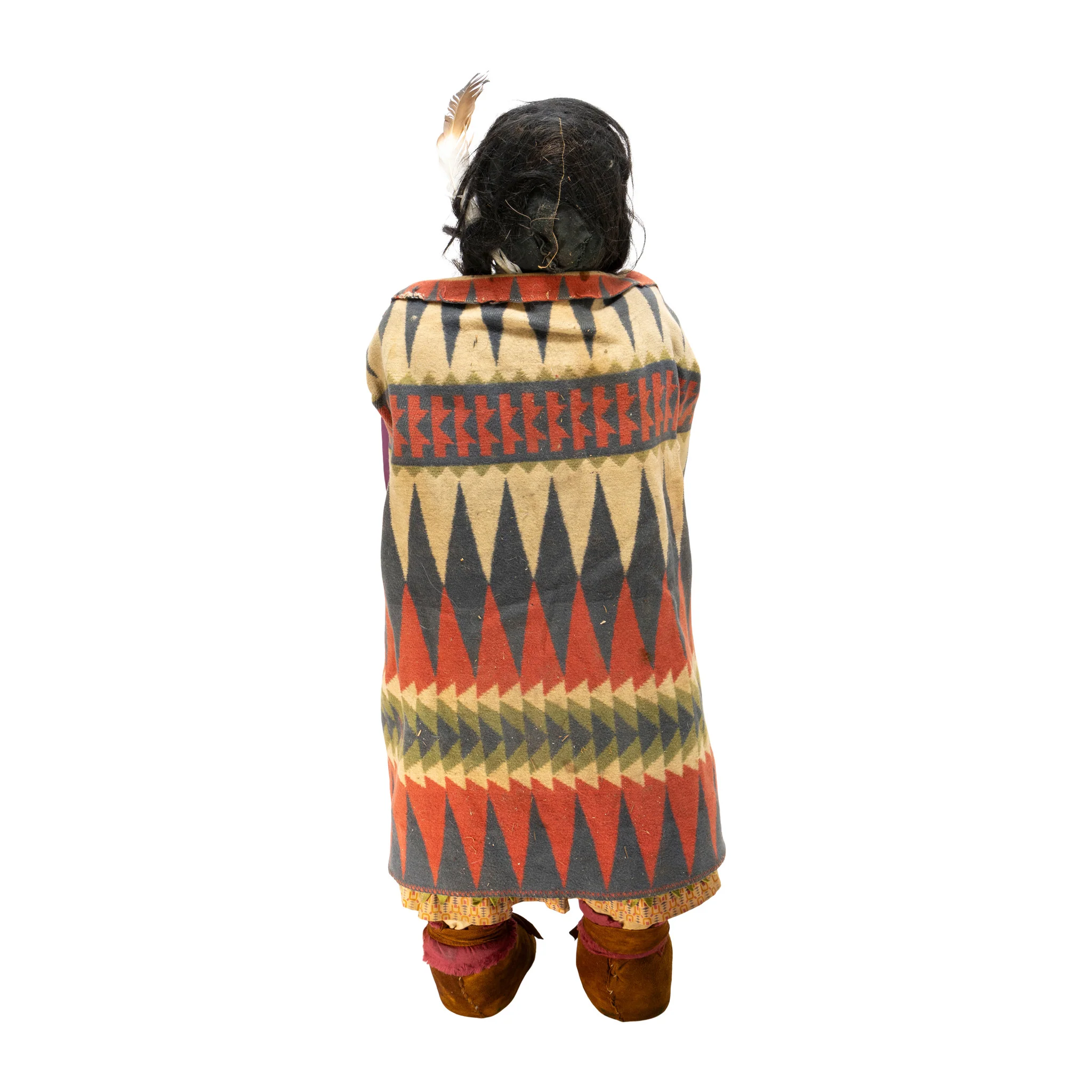
Child sized figure known as a Skookum, an early form of this collectible doll that was used as a store display to advertise Skookums. The detail in this doll is exquisite, he is constructed with a wooden frame covered with cotton cloth stuffed with straw and a wood pulp / papier-mache (composition) head complete with human hair braids, a colorful felt shawl, leather moccasins, feather, and heishi shell jewelry. Under the shawl the stuffed arms are crossed and pinned in place to his clothing; a floral cotton smock and skirt with felt appliques. This realistic rendering is also a prize-winning example; pinned to the shawl is a first-place winner ribbon from the September 11th, 1971, Western Relic Show in San Jose, California and the verso has the entry tag for the doll category judged by Fred Allen.
Mary McAboy (1876 to 1961) was an American dollmaker of European descent who began her career hand carving apple head dolls but soon switched to a composite material of wood pulp and flour. The Skookum name comes from Chinook slang for strong or mighty, and the company slogan was "Bully Good." The dolls were patented by McAboy in 1913 and produced by H.H. Tammen Company. Dolls made after 1940 were plastic- this is an earlier example likely made around 1913 to 1918, indicated by the composition: papier-mache and wood pulp head, human hair, and leather moccasins. The later mid-20th century dolls were plastic or had composition feet and mohair wigs. The costumes were loosely styled after Plains and Southwestern tribes such as Pueblo and Sioux- the heishi shell necklace indicates a Southwestern Native person. McAboy oversaw the production of these dolls and was the head of Skookum assembly, until her retirement in 1952.
Mary McAboy (1876 to 1961) was an American dollmaker of European descent who began her career hand carving apple head dolls but soon switched to a composite material of wood pulp and flour. The Skookum name comes from Chinook slang for strong or mighty, and the company slogan was "Bully Good." The dolls were patented by McAboy in 1913 and produced by H.H. Tammen Company. Dolls made after 1940 were plastic- this is an earlier example likely made around 1913 to 1918, indicated by the composition: papier-mache and wood pulp head, human hair, and leather moccasins. The later mid-20th century dolls were plastic or had composition feet and mohair wigs. The costumes were loosely styled after Plains and Southwestern tribes such as Pueblo and Sioux- the heishi shell necklace indicates a Southwestern Native person. McAboy oversaw the production of these dolls and was the head of Skookum assembly, until her retirement in 1952.
PERIOD: Early 20th Century
ORIGIN: Montana, United States
SIZE: 7" L x 13" W x 37" H
$1,575.00
Original: $4,500.00
-65%Skookum Store Display Doll—
$4,500.00
$1,575.00More Images


Skookum Store Display Doll
Child sized figure known as a Skookum, an early form of this collectible doll that was used as a store display to advertise Skookums. The detail in this doll is exquisite, he is constructed with a wooden frame covered with cotton cloth stuffed with straw and a wood pulp / papier-mache (composition) head complete with human hair braids, a colorful felt shawl, leather moccasins, feather, and heishi shell jewelry. Under the shawl the stuffed arms are crossed and pinned in place to his clothing; a floral cotton smock and skirt with felt appliques. This realistic rendering is also a prize-winning example; pinned to the shawl is a first-place winner ribbon from the September 11th, 1971, Western Relic Show in San Jose, California and the verso has the entry tag for the doll category judged by Fred Allen.
Mary McAboy (1876 to 1961) was an American dollmaker of European descent who began her career hand carving apple head dolls but soon switched to a composite material of wood pulp and flour. The Skookum name comes from Chinook slang for strong or mighty, and the company slogan was "Bully Good." The dolls were patented by McAboy in 1913 and produced by H.H. Tammen Company. Dolls made after 1940 were plastic- this is an earlier example likely made around 1913 to 1918, indicated by the composition: papier-mache and wood pulp head, human hair, and leather moccasins. The later mid-20th century dolls were plastic or had composition feet and mohair wigs. The costumes were loosely styled after Plains and Southwestern tribes such as Pueblo and Sioux- the heishi shell necklace indicates a Southwestern Native person. McAboy oversaw the production of these dolls and was the head of Skookum assembly, until her retirement in 1952.
Mary McAboy (1876 to 1961) was an American dollmaker of European descent who began her career hand carving apple head dolls but soon switched to a composite material of wood pulp and flour. The Skookum name comes from Chinook slang for strong or mighty, and the company slogan was "Bully Good." The dolls were patented by McAboy in 1913 and produced by H.H. Tammen Company. Dolls made after 1940 were plastic- this is an earlier example likely made around 1913 to 1918, indicated by the composition: papier-mache and wood pulp head, human hair, and leather moccasins. The later mid-20th century dolls were plastic or had composition feet and mohair wigs. The costumes were loosely styled after Plains and Southwestern tribes such as Pueblo and Sioux- the heishi shell necklace indicates a Southwestern Native person. McAboy oversaw the production of these dolls and was the head of Skookum assembly, until her retirement in 1952.
PERIOD: Early 20th Century
ORIGIN: Montana, United States
SIZE: 7" L x 13" W x 37" H
Product Information
Product Information
Shipping & Returns
Shipping & Returns
Description
Child sized figure known as a Skookum, an early form of this collectible doll that was used as a store display to advertise Skookums. The detail in this doll is exquisite, he is constructed with a wooden frame covered with cotton cloth stuffed with straw and a wood pulp / papier-mache (composition) head complete with human hair braids, a colorful felt shawl, leather moccasins, feather, and heishi shell jewelry. Under the shawl the stuffed arms are crossed and pinned in place to his clothing; a floral cotton smock and skirt with felt appliques. This realistic rendering is also a prize-winning example; pinned to the shawl is a first-place winner ribbon from the September 11th, 1971, Western Relic Show in San Jose, California and the verso has the entry tag for the doll category judged by Fred Allen.
Mary McAboy (1876 to 1961) was an American dollmaker of European descent who began her career hand carving apple head dolls but soon switched to a composite material of wood pulp and flour. The Skookum name comes from Chinook slang for strong or mighty, and the company slogan was "Bully Good." The dolls were patented by McAboy in 1913 and produced by H.H. Tammen Company. Dolls made after 1940 were plastic- this is an earlier example likely made around 1913 to 1918, indicated by the composition: papier-mache and wood pulp head, human hair, and leather moccasins. The later mid-20th century dolls were plastic or had composition feet and mohair wigs. The costumes were loosely styled after Plains and Southwestern tribes such as Pueblo and Sioux- the heishi shell necklace indicates a Southwestern Native person. McAboy oversaw the production of these dolls and was the head of Skookum assembly, until her retirement in 1952.
Mary McAboy (1876 to 1961) was an American dollmaker of European descent who began her career hand carving apple head dolls but soon switched to a composite material of wood pulp and flour. The Skookum name comes from Chinook slang for strong or mighty, and the company slogan was "Bully Good." The dolls were patented by McAboy in 1913 and produced by H.H. Tammen Company. Dolls made after 1940 were plastic- this is an earlier example likely made around 1913 to 1918, indicated by the composition: papier-mache and wood pulp head, human hair, and leather moccasins. The later mid-20th century dolls were plastic or had composition feet and mohair wigs. The costumes were loosely styled after Plains and Southwestern tribes such as Pueblo and Sioux- the heishi shell necklace indicates a Southwestern Native person. McAboy oversaw the production of these dolls and was the head of Skookum assembly, until her retirement in 1952.
PERIOD: Early 20th Century
ORIGIN: Montana, United States
SIZE: 7" L x 13" W x 37" H